

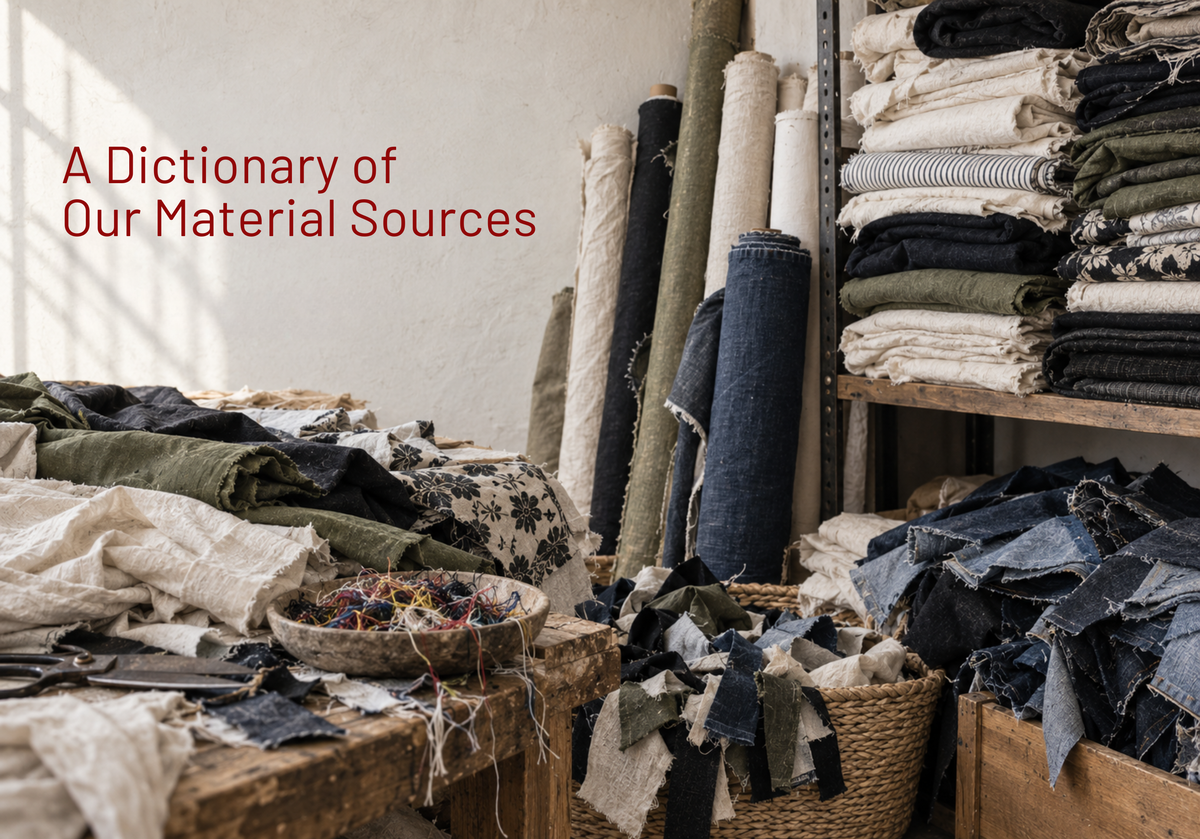
A Dictionary of Our Material Sources

A Dictionary of Our Material Sources
From factory offcuts and end-of-roll lengths to thread remnants and bio-derived textiles, this is where Ekatran's materials begin.
The fabric cut away on a factory floor. The last few metres left on a roll. A rejected length with a minor irregularity. A sample that has served its purpose. A textile sitting unused in a boutique.
For much of the industry, these materials have reached the end of the line. For us, they are filled with possibility.
Ekatran began with katran: the Hindi word for a small cutting or scrap of fabric. Since then, our material vocabulary has expanded, but the instinct remains the same. We look closely at what already exists, understand what it can do, and let its scale, texture and history shape the design.
Where Our Fabrics Come From
Here is a dictionary of the sources that enter our studio from different points across the fashion and textile ecosystem.
1. Factory Post-Cutting Offcuts
Every garment begins with a cutting plan, and almost every cutting process leaves something behind. Factory post-cutting offcuts vary in shape, size, colour, weave and fibre. Their irregularity asks us to work differently: by joining, layering, appliquéing or placing each fragment where it can become part of the garment's language.

2. Deadstock Fabrics
Deadstock refers to fabric that was produced but never used or sold through its intended cycle. It may remain after an order changes, a collection closes or demand is misjudged. Working with deadstock allows us to use an existing textile without commissioning a fresh production run. Quantities are often finite, so the garments made from it may be limited too.

3. Fabric Rejects
Not every fabric makes it through conventional quality checks. Inconsistent weaving, colour variation, printing shifts or other minor irregularities may cause an otherwise usable textile to be rejected. We assess each fabric for function and durability, then decide whether its deviation can become character rather than something to conceal.
 4. End of Roll Fabrics
A roll does not have to be empty to be considered finished by the industry. The remaining length may be too small for a standard production order but exactly enough for a panel, shirt, skirt or a short series. End-of-roll sourcing naturally places a limit on repetition, making availability part of the design rather than an inconvenience.

5. Mill Surplus
Textile mills sometimes produce more material than a particular order or production cycle ultimately requires. If that surplus remains unwanted, we can redirect it into new garments. Because the yardage may be more consistent than small offcuts, mill surplus can support larger forms while still beginning with material that already exists.

6. Boutique Discards
Boutique katran is where the idea of Ekatran first germinated. Tailoring and boutique floors generate small cuttings that are rarely collected for resale and can easily be thrown away. Many of our earliest one-of-a-kind designs were built entirely from these fragments. Small, unpredictable and full of colour, they continue to remind us that scale does not decide value.

7. Sampling Waste
Before a garment reaches its final form, there may be prototypes, test pieces and sampling rounds. These experiments can leave behind usable cloth or complete components that no longer fit the final brief. We see them as materials with a previous chapter, not materials without a future, and rework them when their condition allows.
 8. Denim Offcuts
Denim is one of the materials we return to often. Post-cutting pieces arrive in different washes, weights and weaves, and those variations are precisely what make them interesting. Through patchwork, visible stitching, appliqué and surface manipulation, separate fragments begin to read as one evolving canvas.
 9. Bio-Derived Fabrics
Our material practice is not limited to discarded cloth. We also explore bio-derived and alternative fabrics that incorporate fibres made from agricultural or food-industry by-products. Our work has included GOTS-certified blends associated with aloe vera and orange peel, as well as milk fibre. These materials are commonly blended with other fibres to achieve the strength, handle and durability required for clothing. We treat them as one part of a wider material enquiry, not as a perfect or universal solution.
 10. Post-Production Garment Leftovers
Sometimes the most interesting material is already part of a garment in our studio. A pocket, collar, sleeve, facing or panel may remain after production or alteration. We separate useful components and reconstruct them in a new context. The original function is still visible, but its role changes; a familiar detail becomes the starting point for another composition.
 11. Thread Remnants
Lengths of thread are easy to overlook because each one appears insignificant on its own. In the studio, we collect remnants from stitching and embroidery and bring them back through handwork, textured surfaces, tassels or other details where appropriate. Their value lies not in pretending that every strand can be saved, but in noticing how much can accumulate when no one is looking.
 12. Surplus Trims and Narrow Remnants
Dori, binding, piping, tape, lace and thin strips of fabric often sit outside the category of 'fabric', yet they carry colour, line and texture beautifully. We use these surplus trims and narrow remnants to draw across a garment: to edge a seam, build a cord, create a tie, form a tassel or interrupt a surface. What production treats as an awkward leftover can become the smallest and sharpest detail.
 Material First Always
These categories often overlap. A deadstock textile may also be an end-of-roll length; a factory offcut may later become a thread-rich embroidered panel; a rejected fabric may be useful precisely because of the mark that caused its rejection. This is not a rigid classification system. It is a way of making the hidden routes of cloth more visible.
The source is only the beginning. Once a material enters our studio, we respond through patchwork, appliqué, hand embroidery, visible mending, natural dyeing and reconstruction. We do not force every fragment into the same aesthetic. We let its limitations and possibilities lead.
The result is wearable art shaped by material, process and instinct: garments for people who find beauty in individuality, character and things that evolve with time.
Read more
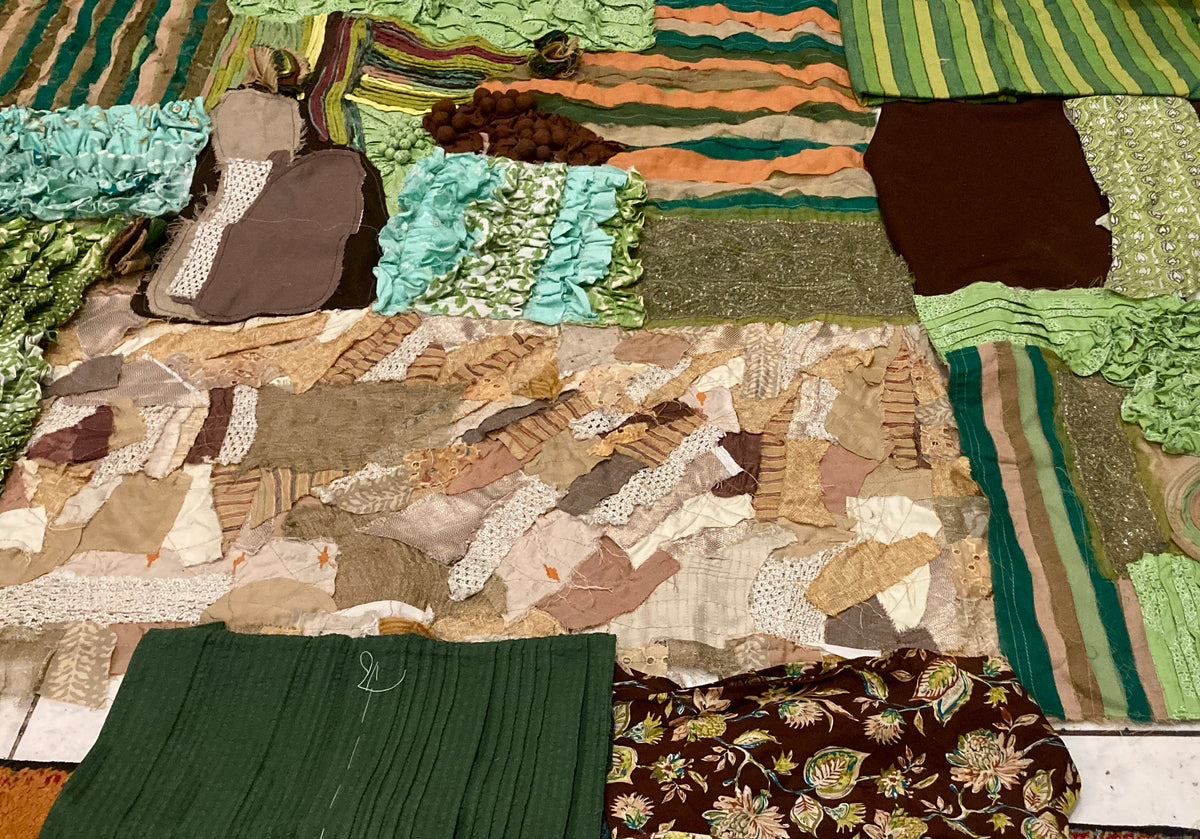
When Fragments became Wearable Canvases
Some pieces were never meant to be garments. They began as surfaces, like canvases stretched out on the studio table. There was no intention of wearability in the beginning. No fixed silhouette, no...
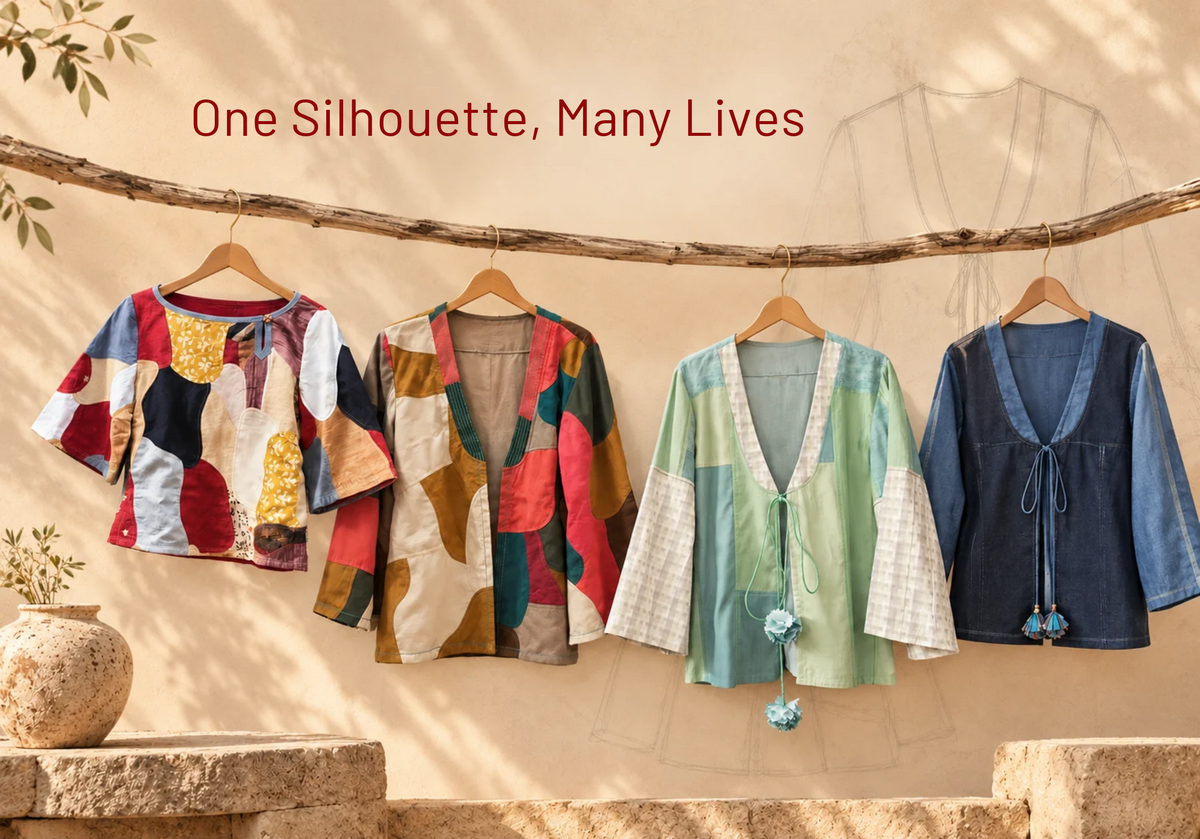
One Silhouette, Many Lives: The Evolution of Ekatran’s Kurti Jacket
How a one-of-one patchwork experiment slowly became the Midnight Tie-Up. Some garments arrive fully formed. This one took the longer route. Before it was the Midnight Tie-Up, we simp...