One Silhouette, Many Lives: The Evolution of Ekatran’s Kurti Jacket

One Silhouette, Many Lives: The Evolution of Ekatran’s Kurti Jacket
How a one-of-one patchwork experiment slowly became the Midnight Tie-Up.
Some garments arrive fully formed.
This one took the longer route.
Before it was the Midnight Tie-Up, we simply called it the Kurti Jacket.

The name was quite literal. We wanted something that could behave like a jacket — something you could throw over another garment, without losing the ease and familiarity we associated with Indian clothing. It sat somewhere between the two worlds: not exactly a kurti, not exactly a conventional jacket.
So, Kurti Jacket it was.
At the beginning, the Kurti Jacket was less a finished “style” and more a place to put fragments together.
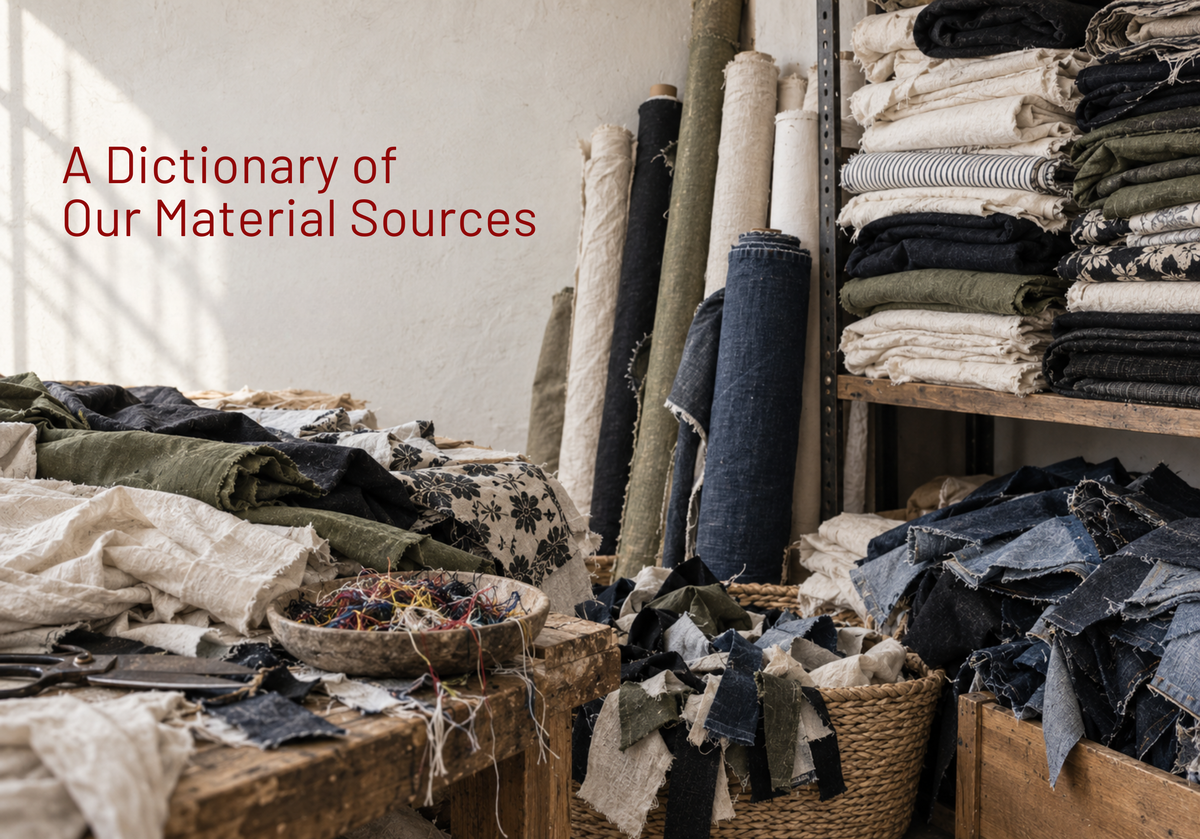
There was silk. There was cotton. There were mixed pieces of katran left from whatever else had been made. Sometimes the colours agreed with each other; sometimes they did not particularly care to.

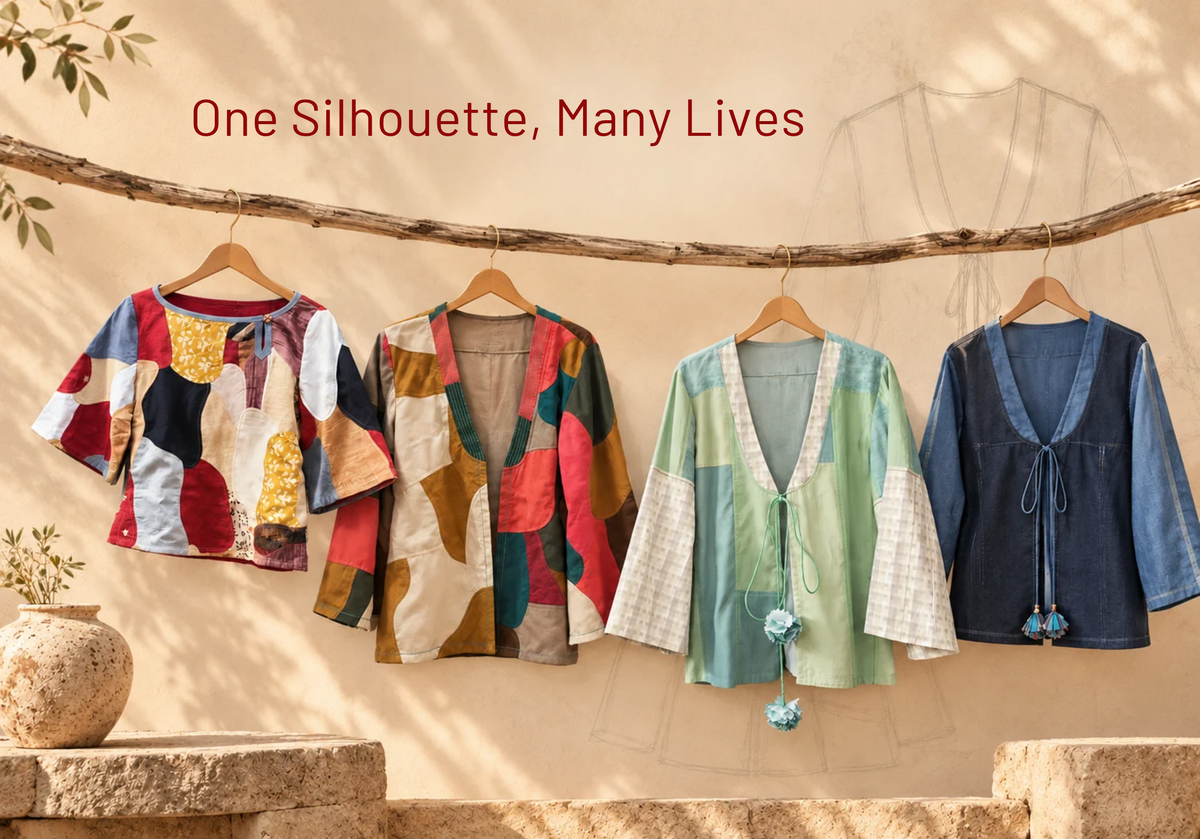
We began arranging them through what we came to think of as organic patchwork: irregular shapes meeting other irregular shapes, with the composition emerging from what was available rather than from a repeatable grid. These early versions were one-of-one because the material itself made repetition difficult. That way of working is consistent with Ekatran’s broader material history. The earliest one-of-a-kind designs grew from small boutique discards, and that irregular offcuts ask to be joined, layered, appliquéd or positioned according to their particular shape and character.

There is a useful distinction here. “Organic patchwork” is Ekatran’s description of this irregular visual language rather than a historical textile category. Patchwork itself simply means joining pieces of cloth to create a larger surface. According to the V&A Museum, remnants have long been part of that practice, although patchwork has also been used deliberately for decoration and artistic composition rather than only economy.
For us, the important part was that the scrap was not being hidden.
It was doing the drawing.
A curved edge suggested the next panel. A small piece of silk could interrupt a larger field of cotton. Colour moved according to what was on the table that day. The jacket remained recognisable, but the surface was impossible to predict.
That unpredictability was the first language of the piece.
Then the fragments became larger.

The colour-blocked Kurti Jackets were, in retrospect, an early act of editing. Instead of asking many small pieces to speak at once, we began creating broader areas of colour, sometimes still interrupted by organic patchwork.
The difference sounds simple, but visually it changed the balance of the garment. The early pieces asked you to notice every junction. Colour blocking allowed the eye to read the whole silhouette sooner.
The Kurti Jacket was beginning to separate into two ideas: the form of the garment and the treatment of its surface.
That distinction became even clearer when denim entered the story.
Denim gave the experiment a different kind of structure.

Rather than relying primarily on contrast between silk, cotton, prints and colour, the composition could now happen within one material family. Dark denim could meet faded denim. Different weights and washes could create variation without the garment becoming multicoloured. Ekatran continues to describe denim offcuts in precisely those terms: pieces arrive in different washes, weights and weaves, and the studio works with them through patchwork, stitching, appliqué and other surface manipulations.
Denim also brought a certain toughness to the experiment. Historically, its durability helped make it a workwear textile, but fashion designers have repeatedly moved it far beyond that origin; the Museum at FIT’s denim archive traces the material through work clothes, leisurewear and high fashion. For the Kurti Jacket, that dual identity was useful: denim could feel familiar and everyday while still becoming a canvas for fairly elaborate construction.
This is where the interlock experiments became important.

In the denim iterations that followed, separate panels were arranged so that the joins themselves became part of the image. Instead of patchwork functioning mainly as a mosaic of colour, seam and edge became graphic elements.
Interlock remains part of Ekatran’s documented denim vocabulary elsewhere: the current archive includes garments in which denim post-cutting panels are secured with visibly contrasting interlock stitching.
After enough silk, cotton, scraps, colour blocks, denim washes and interlocking lines had passed through the same basic form, the silhouette had begun to prove itself independently of the surface treatment. It could survive simplification.
That is where the Midnight Tie-Up comes in.
The current garment is cropped to the waist and relaxed through the body, with a deep U-shaped or scoop neckline. It closes with a front tie finished in katran tassels; the sleeves are three-quarter length and slightly flared, and the body has soft paneling with sometimes restrained patchwork lines running across the front and back.
The material is still not anonymous. Ekatran lists cotton denim alongside denim post-cutting excess and rejects in assorted washes and weaves, sourced from factory-discarded offcuts. The page currently specifies roughly two metres of textile offcuts and seven hours of making per garment.
But compared with the archive pieces, the hierarchy has reversed.

Before, you might first have noticed the patchwork and then discovered the jacket.
Now, in the Midnight Tie-Up, you notice the jacket and then the traces of patchwork sometimes.
That change matters because simplification did not mean removing the earlier language completely.
The tie still ends in katran tassels. Different denims still meet each other. Patchwork versions are still visible. Even within a repeatable product, the brand states that hand-selected katran produces natural differences in shade and fabric from piece to piece.
It is not the rejection of the one-of-one years.
It is their compression.
And alongside it sits Midnight Patches, described in the studio chronology as another repeatable version that lets a small amount of the interlock language return. Instead of covering the garment with construction, those details behave almost like punctuation — a reminder of the denim experiments.
Perhaps that is also why this silhouette has lasted.
The current Midnight Tie-Up sits in Ekatran’s Core range and in its Most Loved edit, making it one of the clearest publicly visible examples of an experiment becoming a recurring Ekatran garment. Ekatran’s own description of its practice says that some explorations remain singular while others evolve into recurring signatures; its Signatures collection similarly describes a movement in which certain iterations become simpler and more suited to everyday wear while others become more layered and art-led.
There is a practical reason for that staying power too.

A cropped, open-front layer does not insist on one complete outfit. It can sit over a vest or tank in warmer weather. It can meet trousers or denim and feel entirely casual. It can be worn over Indian separates without becoming a conventional ethnic jacket. When the weather changes, the same loose shape can take a longer sleeve underneath it.
So the thing people appear to return to may not be one particular patch.
It may be the space the garment leaves around itself.
Enough Indian familiarity to carry a memory of the kurti. Enough openness to act like a jacket. Enough personality to feel like Ekatran. Not so much instruction that there is only one way to wear it.
Looking back, the interesting part is not that the Kurti Jacket changed.
It is what did not change.
Silk became cotton. Cotton met whatever katran was left. Small fragments became colour blocks. Colour became tonal denim. Denim became interlocking lines. Those lines eventually quietened into the restrained construction of the Midnight Tie-Up and Midnight Patches.
The surface kept evolving until we could see what had been underneath it all along: a silhouette worth keeping.